You have notes. Now let's talk about time.
If you made it through Workshop 1, you wrote melodies using nothing but pitch. No rhythm rules — every note was basically the same length. That was intentional. One variable at a time.
Now we're adding rhythm to the toolkit. In this workshop you'll compose short pieces using a small set of rhythmic cells — fixed patterns of note durations that repeat and vary across a melody.
You ready?
For this exercise, compose a short 8-measure piece using only these two rhythmic cells:
Write your piece in 4/4, but notice that the first cell is 3 beats and the second is 2, so unless you are just looping the second cell, your patterns won't align well with the 4-beat meter. That's intentional. The idea is to build up a lot of variety, using a small amount of source material.
The rules:
- Use only these rhythmic cells.
- Use only a single pitch. Doesn't matter which one. Can just be snapping or clapping or something.
- Sing or play (or count!) your composition when you're done.
Some things to think about: Try to give your composition some feeling of cohesion by repeating a section at some point, maybe end with the same pattern (or group of patterns!) that you begin with, but do something different in the middle.
Try very hard to stick to the spirit of this exercise, but if you feel like you need to pad out a measure in the middle so you can start a pattern at the beginning of a bar, that's fine. Similarly, if you need to add a beat or two at the end that's fine. Don't overdo it!
Don't overthink this stuff. It doesn't have to be perfect, just play with things until you're happy and move on!
Here's an example composition for this exercise:
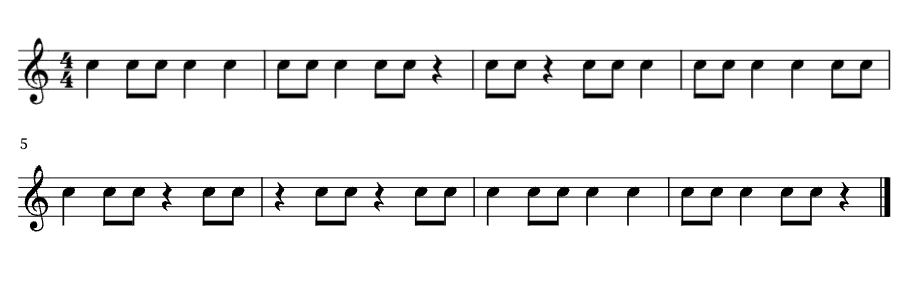
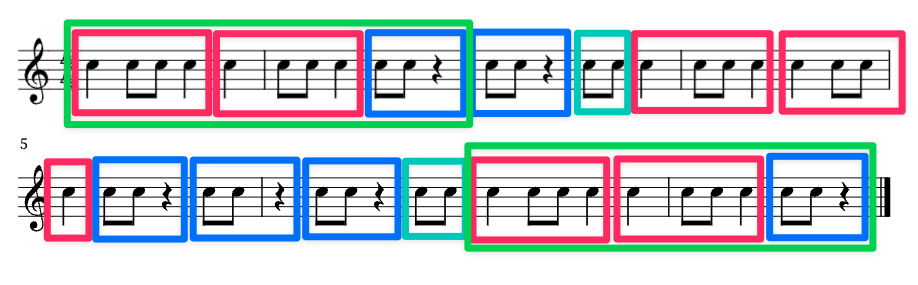
And here it is with all the cells highlighted.
- Cell 1 is highlighted in red.
- Cell 2 is highlighted in blue.
- The green highlighted section starts the piece and also comes back at the end.
- In two places, Cell 2 is shortened (the rest is missing!) to make the thing flow a little better, and to set up the repetition at the end. The shortened Cell 2 is highlighted in teal.
Take your rhythm-only composition from exercise 1 and add some notes! Just like our first workshop, the note set is intentionally slim.
Use one of these cells: (play them both, choose whichever you prefer)
The rules:
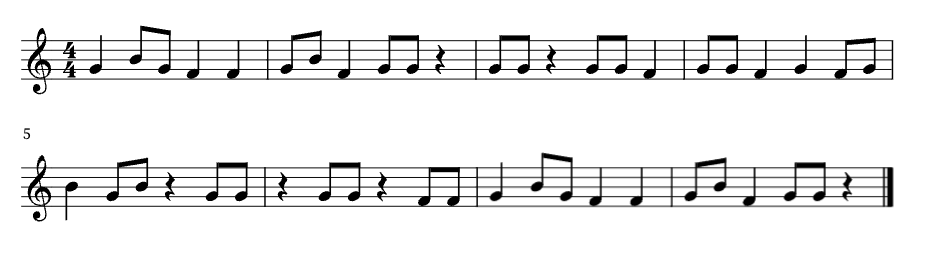
- DO NOT strictly align your pitches to the cells, keep the movement of the pitches independent of the rhythm for the most part. (An exception to this rule is if you ever put in a clear repetition, like the green highlighted beginning/ending of the example composition above, those can use the same pitches if you want.)
- Sing or play your composition!
Here is the previous example, now with pitches!
Exact same rules and ideas as above but this time create your own rhythmic cells.
The rules:
- Create 2 unique cells, don't use anything smaller than an 8th note.
- The cells should be of different lengths, and should add together to create an odd number of beats.
- No cells longer than 5 beats.
Adding Pitch:
- Same rules as above, select your own small pitch set, no more than 5 pitches.
You might be feeling like your compositions are a little basic. You aren't wrong, but surely you can see that we're building toward something here! The instincts and ideas you're building here doing these somewhat simple exercises are going to be crucial once we start to flesh things out in the next few lessons.
The basic idea of working within creative constraints will be incredibly valuable, especially as we expand your toolbox.